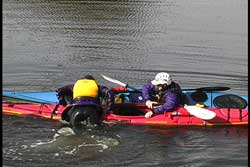
Re-Enter And Pump Assisted Recovery
By Wayne Horodowich
A kayaker should have a number of recovery methods to choose from in their bag of skills. I feel the most basic assisted recovery is the re-enter and pump. It is simple and very time efficient when it comes to shorter immersion time for the paddler in the water. The only requirement is a pump.
There are a number of assisted recoveries that have the assisting kayaker drain the water from the kayak before the paddler in the water re-enters their kayak. See USK article, "T-Recovery" as one of the typical kayak draining recoveries. Draining the water before re-entry does get the water out more quickly, however it keeps the paddler in the water longer. In very rough conditions trying to drain a kayak can be difficult and opens the assisting kayaker to a potential capsize while trying to drain the kayak. The re-enter and pump recovery provides reliable support for both kayakers.
The re-enter and pump can also be performed with any type of paddle craft. A single can assist a double or a double can assist a single. It doesn't matter if a kayak is full off gear or not. As long as the overturned kayak can be righted the assisting paddler can hold it for the recovery.
This recovery begins by turning the overturned kayak upright. This can be done by the paddler in the water, by the assisting kayaker or they can work together. It is not very difficult to roll a kayak upright especially when two paddlers work together.
When you perform an assisted re-enter and pump recovery, your job as the one assisting is stabilizing the kayak so the paddler in the water has a stable platform to climb on to his or her kayak in order to get back into their cockpit. In this series of photos we will see the paddler re-enter their kayak over their back deck. There are many different re-entry methods one can choose from when their kayak is being held by a partner. Remember the USK motto, "Do it in a way that works best for you."
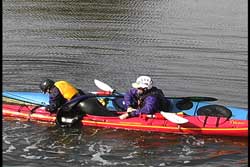
There are numerous methods for and positions for stabilizing a kayak. I prefer the bow to stern stabilizing position when holding a kayak as demonstrated in the photo. I believe the assisting paddler has more options when they support the other kayak in this manner. The biggest advantage is being able to see the paddler as they re-enter the kayak and you can continuously monitor them because they are facing you. In addition, it is always easier to communicate when you are facing your partner. There is an added benefit if your paddling partner is also your sweetheart. After we hold the kayak for each other there is a toll of at least one kiss that needs to be paid This method of holding also keeps the assister's arms out of the cockpit so the cockpit is not blocked.
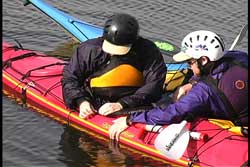
When I hold the kayak for my partner I can also direct them into their cockpit and give feedback as needed. It is common to physically guide your partner's feet into the cockpit. I want my partner to know their kayak is stable and I will not let them go over while they are going through the re-entry process and getting themselves back together before we continue on our journey.
I am not only there for the physical support, I am also there for emotional support. It is very common for a capsized paddler to be anxious after their capsize. As I sit there facing my partner both of us can relax because I am resting on their boat which stabilizes both of out kayaks. While resting there we can use that time to help the recently capsized paddler to collect their thoughts and change clothes if needed and if their are clothes readily available.
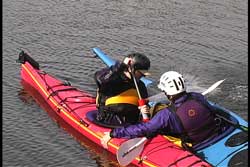
Once the paddler is back into their cockpit and their clothing is straightened out, the pumping can begin. I am a firm believer of everyone carrying their own pump and paddle float. Aside from having extra pumps as a back up in case of a loss or malfunction, extra pumps also means faster pumping times if two or more are pumping at once.
Another benefit of pumping is the heat that is generated by those pumping. If the paddler in the water was getting chilled pumping out water can help increase their body heat.
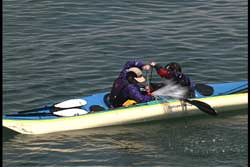
Here we see two paddlers both pumping out one cockpit. The assisting boater is pumping out the flooded kayak while they comfortably rest their body over the deck of that kayak. This essentially cuts the pumping time in half. If there were a third boater there is no reason why they couldn't come along the other side of the flooded kayak and add their pump to the process.
If the flooded kayak has bulkheads pumping time is not very long. If there are no bulkheads the pumping time will increase depending on the presence and the size of the internal float bags. If there are no float bags and no bulkheads you run the risk of your kayak sinking. If it doesn't sink it will take a lot of pumping time to get the water out if there were no float bags or bulkheads.
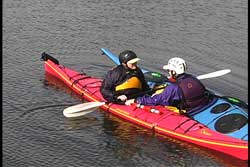
As always, the paddler who is providing the support does not let go of the other kayak until the partner tells them it is OK. Don't assume they are ready because they may counting on the support and a simple look over the shoulder could result in another capsize. Specific and clear communication is important.
The re-enter and pump assisted recovery is a no frills, highly reliable recovery method. The assisting kayaker uses the capsized kayak as a support as they hold the kayak as a support for the paddler in the water. In rough conditions the support provided to both paddlers is very comforting.
I especially like this method because I can use it on any kayak regardless of the size of the kayak or how much gear is in it or how much water is in it. I also know I will not be straining myself trying to lift a kayak in order to drain it.
This method also gets the paddler out of the water in the quickest amount of time. Therefore, if the capsized paddler is not dressed for immersion this should be your recovery of choice. Even if you do not have a pump just getting the paddler out of the water may be life saving. In a pinch you can empty water out of the kayak by using the "On the water kayak repair" method to drain water. At least it keeps the other paddler out of the water if they are not properly dressed. As always, if you dress for immersion you provide more options for your own survival.
As with any recovery method I encourage you to practice it before you need actually need it.
Pictures seen above were taken from the USK Video "Capsize Recoveries & Rescue Procedures"
Updated 5-3-2009
© Copyright USK