Low Brace Turn
By Wayne Horodowich
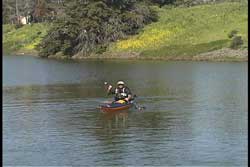
I have to admit that one of the skills I have high on my favorites list is the low brace turn while on the move. I enjoy this skill because it provides incredible support for exaggerated edging, looks very graceful, produces an excellent decelerating turn and is a great foundation drill for many other strokes and skills.
The key to this skill is to get good forward momentum in your kayak. Once your kayak is moving it also means your paddle will be moving with respect to the water. If your paddle is placed properly on the water there will be considerable lift on the blade due to the movement provided by the kayak. This lift provides support so you can execute the skill.
Remember there are two ways to get lift on your paddle. Place your paddle properly on the water surface while the kayak is moving or move your blade on the water with a climbing angle on the blade. Either way gives you support.
Knowing how to control your blade position and angles is important for this skill. Having a good understanding of blade manipulaqtion is important. See USK article, "Sculling."
As I mentioned above, you need to get some forward momentum to do this skill. Having an efficient forward stroke makes it easier. The faster you go the more support you will feel from your paddle.
If you want the most power from your stroke you want to use the recommended criteria to an efficient forward stroke. Good torso rotation, vertical paddle shaft, shorter stroke length are the three main ingredients for an efficient forward stroke. However, you have to included power into the equation if you want to get greater speed. Just having a model stroke doesn't provide the speed. An efficient stroke makes the best use of your power but yoy still need to add power if you want tho get lots of speed.
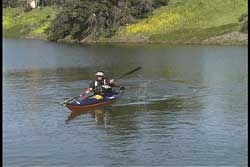
When you reach your desired speed and you know if it is a right or left turn you will want to take a set-up stroke before you brace. In this example I am planning on doing a left hand turn. Therefore, the last stroke I take before the brace is a right side sweep stroke. This will start turning my kayak to the left. This set-up stroke will allow me to get more turn from my low brace moving turn.
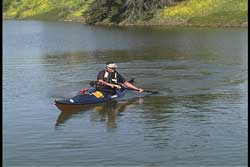
Now that I have forward momentum and I have performed my set up stroke on the opposite side of my turn, I put my paddle into a low brace position which means I will use the back surface of my blade.
I turn to look behind me on the side to which I am turning. As I turn, I lift my opposite (outside) knee up into the top deck/thigh supports of my kayak. I call this a knee hang. The knee naturally goes there as you turn to place your blade behind you. The paddle is placed at a 45 degree behind you (the angle of the paddle shaft with respect to the kayak). The blade is placed flat on the water with the back face on the water.
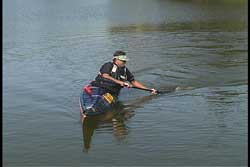
Once you are in this position there will be a lot of positive lift provided to the paddle. With this support you can edge your kayak and even lean your body out over the water (beyond the stationary capsize point) because of the lift provided by the blade moving on the water. The reason you want to edge &/or lean is due to the increased turning potential when a kayak is on edge.
There is no need to rush. Just keep that paddle in the water behind you with the blade flat and enjoy the glide. Your kayak will turn and you will begin to slow down. The more you can put your kayak on edge the sharper the turn. The more you push down on the paddle the sooner the paddle will sink, which quickens your deceleration. Therefore don't try to push your paddle down when you should be gliding instead.
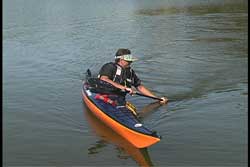
When the kayak slows down the support from the paddle decreases. You will see your paddle begin to sink if you keep the same amount of weight on it. The more you practice this skill the less panic you will feel as you slow down.
Since it takes time for a sea kayak to turn you want to maximize your glide time. That is why pushing down is not recommended. Again, don't try to ruch this maneuver. Think of it as a little ballet move on the water. It is a very fluid stroke. If you have too much bend in your elbow on the bracing side your blade will be closer to the kayak. To get more turn and support reach the working blade out a bit.
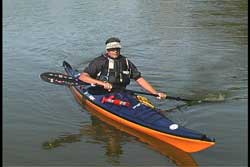
As I mentioned above, you can get increase support from your paddle if you move it through the water. Therefore, as you slow down and feel the need for more support, I recommend you do a slow reverse sweep stroke with a climbing angle on the blade. The movement of the blade with the correct climbing angle will increase your support. Use this support to bring your body back over the stationary capsize point of your kayak.
You should finish this maneuver with your body centered over your cockpit. Your paddle will be recovering with the working blade exiting the water up by your feet.
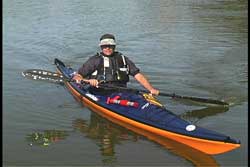
Remember, to keep a flat blade for support and use a climbing angle as need for additional support when you have to move your paddle for the final support when the kayak slows down.
Again, this is a decelerating turn that is done as you pivot around your low brace while edging and leaning into the turn.
The farther you can reach the paddle blade out from the kayak the more support you will get. It is a simple matter of leverage. I recommend a light grip on the paddle. I have noticed the tighter the grasp on the paddle, the closer the blade is to the kayak.
Since you are in a low brace position the danger to your shoulder is minimal. As you get more comfortable with this skill you will be able to reach out even farther. If this were a high brace I would caution you about reaching too far but a proper low brace position does not stress the shoulder.
This skill provides a wonderful foundation for sculling strokes, body movement for bracing, a supportive backstroke and interactive edging skills. This is my primary stopping turn when I come in for a recovery. This skill is also a good base for a number of combination strokes. When it is done well it looks so graceful. This skill is an essential component when I teach my bracing clinic. See USK's Bracing Clinic video for more details.
The next time you go out try twenty or thirty low brace moving turns and see how far you can edge your kayak during the turn. During my last class I had some folks getting their spray skirts in the water and they have never edged that far before. Enjoy!
Pictures seen above were taken from the USK Video "ABC'S of the Surf Zone"
Updated 5-3-2009
© Copyright USK