Ride A Wave And Side Surf Combo
By Wayne Horodowich
There are many ways to get to shore through a surf zone. You can choose to work against the forces (see USK article, "In-Out Surf Landing"), you can use the forces (I feel like Yoda when I say that) or you can play with combinations of the the two. In this article I will focus on using the forces to get you to shore.
If the waves are not too big, I like taking a quick ride and then use the whitewater of the broken wave to side surf me to shore. I call this the lazy paddlers surf landing, because you really don't need energy to land. You do need to know how to ride a wave and more importantly how to side surf. See USK article, "Side Surfing Control".
Of course this landing method assumes you have a nice clean run to shore without any obstacles (rock, jetties, board surfers, body surfers, etc.) As always, we at USK recommend a helmet when playing in the surf zone. As in all surf zones, secure all items you wish to keep and disconnect paddle leashes. Remember NOT to use your rudder or skeg when landing. Rudders and skegs need to be up so they do not get broken off if you were to side surf all the way up to the beach. The rudders and skegs get lifted when you are in the swell zone.
Before you decide to surf a wave you need to pick your takeoff spot. This is determined when you are out beyond the breaking waves and comfortably sitting in the swell zone. You know you are in the swell zone when your kayak just goes up and down as the swells pass underneath your boat. You are watching the swells move toward shore and looking for the location where the swell begins to steepen which is before the breaking area.
One of the advantages of using a sea kayak is the greater speed that one gets with a longer boat. This speed allows you to catch more waves, because your "take-off" zone is much larger. Surf boards and whitewater kayaks need to be closer to the breaking zone, because their speed is limited.
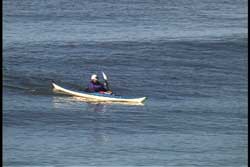
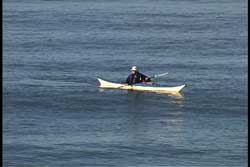
When the swell steepens and you are in front of it with your bow pointing toward shore, the rear of your kayak is lifted first and gravity pulls you down the face of the steepening wave. The pitch on a small wave may not be enough to surf you forward if you are standing still. The wave may lift you and you may begin to slide down the face, but the swell passes you by before you can gain any momentum. However, if you have forward momentum you can get rides on smaller waves, because you are staying in front of the pitching swell as it begins to grow.
If you want to take off from a dead stop, then you need to be where the wave pitches up just before breaking. For the ride and side surf combo, I recommend getting momentum so you can get on the wave sooner. That momentum can also keep you in front of the wave before it breaks.
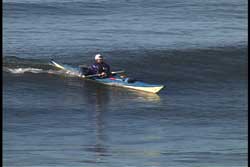
Once you have gained enough speed, the steepening wave will keep you surfing in front if it. You want to keep your kayak perpendicular to the wave, so you can surf straight towards shore. Using a paddle rudder to keep you riding straight is a standard technique used by kayak surfers.
You need to be ready to use the rudder on either side to keep the kayak on course. When a sea kayak begins to turn, it is common for it to continue to turn, so you will need the opposite side rudder and some edging to bring the kayak back to a straight if it goes off course.
Also, don't be surprised if you cannot get your sea kayak out of a turn once it starts carving one. Some designs love to turn and some are difficult and sometimes impossible to straighten out once they have turned too far while riding a wave.

If you turn your kayak too soon, you run the risk of having the wave go underneath your boat, because you are slowing down with respect to the forward movement of the wave. You also run the risk of turning back up over the lip of the wave if you turn too much or too soon. That is OK if you want to ride and get off in order to go back out to catch another wave. See USK article, "Surf A Wave And Get Off."
Remember your goal is to get to shore. As the wave gets steeper the faster you will go. I like to add a few forward paddle strokes to add to my speed when I know the wave is getting ready to break. I prefer to have the wave breaking just behind my kayak rather than on top of me.
You can also ride the wave on an angle and let the wave break right on you and your kayak. If you edge lean and brace correctly, you should come up side surfing to shore. I recommend you do this with smaller waves if you want to try this. Some of the big ones can be nasty with the volume of water that is involved.
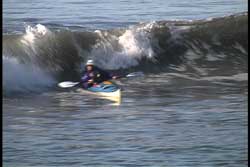
Once a waves breaks we are dealing with different water dynamics. A whitewater wave is moving water. Think of it as a moving wall. This is different than the swells which is water just moving up and down. The reason we move forward on a pitching wave is due to gravity. A whitewater wave is a moving wall that will eventually turn your kayak sideways and then carry the kayak sideways toward shore. Depending on the size of the whitewater, you can be side surfed to shore upright and/or upside down. The wave doesn't care.
Our goal is to stay upright to enjoy the experience. If you allow the broken wave to launch you forward, while still being perpendicular to the wave, you cannot really predict which way you will turn. Since control is key to this combo technique, I recommend that you begin your turn to your preferred side as the wave is breaking. This is done so you will know on which side you need to edge and brace. Use your low brace or high brace to initiate the turn. When you rotate your body to do a low brace or high brace turn, your outside knee is already in the correct position, under the coaming doing a knee hang, which edges your kayak which aids in the turn.
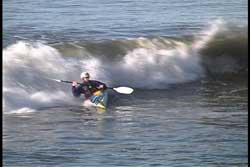
Once the kayak begins the turn and the kayak is angled to the wave, the moving wall of whitewater turns the kayak the rest of the way until the kayak is broached (parallel to the wave.) Depending on how close you are to the point where the wave breaks will determine how much of the breaking force of the wave will hit you. That is why I said I prefer to do this in waves that are not too big. "Too big" is a relative term. Here are my thoughts on wave size based upon watching lots of kayak surfers: novices 1-2 ft waves, experienced surfers 3-6 ft waves and those who enjoy punishment 7 ft and greater.
In this case we see Rod starting his turn as the wave breaks behind him. He went from a low brace turn and changed to a high brace for side surfing. Then he was immediately engulfed by the whitewater of the broken wave. He had his kayak edged properly and was ready with a high brace just before the whitewater hit him.
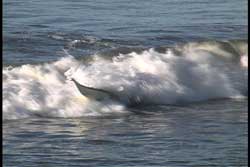
You can see his kayak gets turned by the whitewater. Even though Rod is completely submerged under that froth, he is edging toward the wave and doing a high brace with his elbows pointing down to protect his shoulder. See USK article, "Shoulder Safety".
Once you are engulfed by the whitewater, there is not much to do except hang on and hope you edged and braced properly. It is important to note, even if you do everything correctly you still may get knocked over depending on the forces acting on your kayak. Experience will teach you how much edge and lean is usually enough. You have to pay your dues to King Neptune to learn that bit of knowledge. The dues consists of quick knock-over's. That is why I recommend that you learn to roll if you are going to regularly play in the surf.
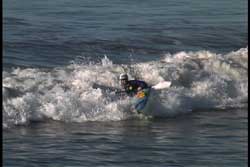
As the whitewater settles down, Rod emerges from underwater side surfing toward shore. He is maintaining his edge and brace. Rod is using a high brace, but a low brace works just as well.
The larger the whitewater wave, the more lift you will have on your bracing blade. If you have a long ride to shore, then this could be a good time to practice switching between high and low braces. If you do decided to play with your braces, make sure you are balanced over your kayak so you can take the weight off of the bracing while switching blade faces.
For me this is the fun part of going toward shore. I get a chance to hang out and watch the scenery while the wave does the work. I also like to practice my forward and reverse supportive sweep strokes , which allows me to move forward or backwards while side surfing. See USK article, "Side Surfing Control."
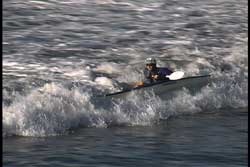
As he side surfs toward shore, Rod tries to get his balance point back over his kayak. Even though there is great support provided by the whitewater wave, that support diminishes as the wave dissipates. Therefore, it is in Rod's best interest to get his balance point back over his kayak. The critical point is keeping his kayak on edge while getting his balance point over the boat. If you sit up straight you will likely capsize. As mentioned in the article referenced above on side surfing, one has more control and options when balanced over their kayak.
One way you can tell if you are balanced over your kayak is to lift the bracing blade temporarily off of the whitewater. It is a little game you can play with yourself. See how long you can lift the blade while staying balanced over your kayak. Of course, it is best to err by balancing closer toward the wave side in case you lose your balance.
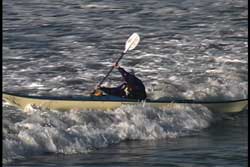
When Rod feels he is close enough to shore, where he can have the wave slide underneath his kayak, he lifts his shore side hand to do a hanging draw to slow his kayak down. When the wave is small enough the hanging draw will provide enough resistance and drag so the wave will go under the kayak. He does this because he prefers to land with his bow pointing toward shore. If he side surfs all the way to shore, he ends up getting abrupt stops when his hull catches in the shallows.
I have had some winter surf days where the I wave was so strong I was unable to get my kayak turned in time before it hit bottom. When my kayak hit shore at that speed I was rolled over, because I didn't realize how much force was pushing my kayak. After that experience, I knew I had to exaggerate my edge when I got close to shore.
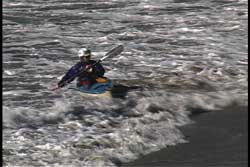
After getting off of the wave Rod does a sweep stroke to turn his bow toward shore. He can follow the wave he was riding or wait for the next wave to take him up the last few feet to his landing. By having his bow toward shore, he will not have his kayak bashed from the side by the waves which are continuing to come ashore. He also has the choice to point his bow toward the ocean and back paddle his last few yards to shore.
Once Rod feels his kayak firmly resting on the bottom he can quickly get out and pull his kayak up the beach to where it is high and dry. I recommend you maintain the greatest control during the last few yards of your landing. There are usually more obstacles closer to shore. Beachcombers, kids at play, dogs chasing kayaks and beach debris await you upon landing.
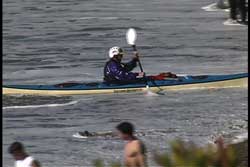
Another reason for not landing sideways is the possibility of getting out on the wrong side of the kayak. If you mistakenly got out on the beach side, the next wave could wash the kayak into you possibly causing injury. That is why we say "never be on the downstream side of a kayak." By pointing your kayak toward shore you eliminate the possibility of a wrong side.
As you can see, this is a lazy paddlers landing. The only exertion is the forward paddle to catch the wave. Then, if you chose, you can paddle forward before the wave breaks to get a little more space between you and the breaking wave. The hanging draw near shore, the sweep strokes and the last few strokes to land do not require a lot of energy as compared to paddling through the entire surf zone and counteracting the multiple waves that would overtake you. The rest of the landing is technique, not muscle.
If you wonder why we don't try to surf straight to shore rather than making the turn as I have suggested, most of the paddlers I see trying to surf straight in usually get turned to the side. The bigger and stronger the waves the faster and sooner they get turned. Sometimes they stay up and sometimes they capsize. They usually capsize because they could not react quick enough to the way the kayak gets turned. That is why I like to control the direction of my turn. The operative word is control.
If you are like me and save your energy for when it is really needed, then I suggest you take advantage of the forces offered to you by King Neptune and take a ride to shore. You may get a little wet, but soon you will be on shore drying off. In addition, these are great skills to master if you intend to launch and land in surf zones on a regular basis. Enjoy the ride.
Pictures seen above were taken from the USK Video "ABC'S of the Surf Zone" , winner of Years Best Video 2005 from Sea Kayaker Magazine Reader's Poll. Thank you Rod Tucknott for a great ride. Rod Tucknott runs UCSB Adventure Programs and is an ACA Instructor.
© Copyright USK